Own the processing plant your community needs.
A USDA-inspected modular meat processing plant on your own ground. Producer-owned, franchise-backed.
Or run your numbers firstFour things you can do in the next ten minutes.
Two minutes, no email. See what your cattle are worth through a pod.
GoNebraska is open now. Claim a 50-mile radius before your neighbor does.
GoInspection, grants, and plant costs, written for producers.
GoGrants and guarantees, with a specialist who works them with you.
GoAmerica consolidated its meat supply. It's time to rebuild it.
Four meatpackers control 85% of the U.S. beef supply. Every animal passes through 5–7 ownership transfers, 1,000+ miles of transport, and anonymous commodity processing — erasing traceability, margin, and producer identity along the way.
Independent processors have closed by the thousands. Producers wait a year for a custom slot. Local consumers can't get local meat — even in cattle country. The infrastructure to close this gap is the missing piece.
Today you keep 51¢ of every beef dollar. Own the pod and the whole dollar runs through your operation.
USDA measures what the farm receives out of each dollar a shopper spends on beef. The other 49¢ pays the packer, the distributor, and the retailer. When the processing and the sale happen on your ground, that 49¢ is yours to earn instead of theirs.
- 51¢ paid to you for the animal
- 49¢ to the packer, distributor, and retailer
- 51¢ farm value, same as before
- 49¢ more per dollar, earned by your pod and your brand, before operating costs
Source: USDA Economic Research Service, Meat Price Spreads, farm share of the retail beef dollar, July 2026 (51%). The 49¢ is gross margin: a pod owner pays labor, utilities, packaging, and financing out of it, so net capture is lower and depends on the operation. Illustrative, not a performance claim; see Item 19 of the FDD.
The Opportunity
A $105B+ retail beef market with growing demand for local, traceable, direct-to-consumer product — and no scalable infrastructure serving independent producers or regional brands.
Where the pod fits.
Today the animal leaves the ranch and so does the margin. With a pod, the producer owns every link from harvest to the shelf.
- 01 Ranch
Cow-calf and backgrounding
Calves raised on producer-member ranches. Identity and traceability start here.
- 02 Feedlot
Finishing on a set program
Local feedlots finish on a specified nutrition plan, so grading and yield are predictable before the animal ever moves.
- 03 Meat Pod
Harvest and aging on site
The animal never leaves the community. Harvest, inspection, chilling, and dry aging happen in the pod.
Buy a pod: you run itFranchise: you run it, we back it - 04 Cut & pack
Fabrication and custom packing
Retail cuts, ground, and value-added product packed and labeled under the producer's own brand.
Buy a pod: on youFranchise: in the Meat Pod chain - 05 Local freight
Short hauls, not long ones
Finished product moves miles, not states, on local trucks to local accounts.
Buy a pod: on youFranchise: in the Meat Pod chain - 06 Shelf
Markets, retail, restaurants, schools
Farmers markets, independent grocers, restaurants, and institutions that want beef with a name on it.
Buy a pod: on youFranchise: in the Meat Pod chain
Green links are the ones a Meat Pod owner controls. Buy a pod outright and links four through six are your job. Franchise, and they are already built: Iron Brand custom packing, Meat Pod freight, and placement on retail shelves, in restaurants, and with institutions.
One chain, producer-owned at every link.
Meat Pod is the second link. Producers and ground come in from Legacy Exchange, the pod harvests and ages on site, Iron Brand cuts and packs, and NFN Farmers Market and its buyers put the beef on the shelf. Every link is built and run by the same producer network.
- 01
Legacy Exchange
Producers and landThe producer network and land marketplace where ranches, ground, and the next generation find each other. This is where the cattle, the sites, and the owners come from.
- 02You are here
Meat Pod
Harvest and aging on your groundThe USDA-inspected plant on the producer's site. Harvest, inspection, and dry aging happen where the animal was raised, under the producer's own brand, with the record following every carcass.
meatpods.com02The same chain, for produceLocal Greenhouse Farms
Growing year-round on your groundA climate-controlled greenhouse on the farmer's own site, harvesting greens for the county every week of the year, run by the same producer network. One chain, two ways to own the middle of it.
localgreenhouse.farm - 03
Iron Brand Custom Packing
Cut, package, and cold storageRegional plants that pick up wholes, halves, and quarters from franchise pods and turn them into labeled, scannable packages and pallets. The overflow capacity that lets a two-module pod run like a four-module plant.
Regional plants, no public site - 04
NFN Farmers Market
The shelf, and hundreds moreProducer-owned retail that puts your beef in front of shoppers under your name, plus placement with hundreds of grocery, restaurant, and institutional buyers across the network.
Buy a pod outright and links three and four are yours to arrange. Franchise a territory and they are already built.
Buy the pod, or plug into the whole chain.
Both paths put a USDA-inspected plant on your ground. The difference is everything around it. Buy a pod outright and the plant is yours, and so is every job downstream of it. Franchise, and the plant drops into a supply and marketing chain that already exists, with the people and compliance handled.
| What it takes | Buy a pod | Franchise a territory |
|---|---|---|
| Modules on your ground | All four: harvest, aging cooler, cut and package, freezer | Two: harvest module and aging cooler. Less to buy, less to finance |
| Harvest and aging on siteSupply chain link | You run it | You run it, on the Meat Pod system |
| Cut, package, and cold storageSupply chain link | Your own modules, your crew | Wholes, halves, and quarters picked up and processed at Iron Brand regional plants |
| Freight and distributionSupply chain link | You arrange it | Meat Pod transportation and distribution |
| Retail shelves, restaurants, institutionsSupply chain link | You find the buyers | Placed through the Meat Pod supply chain |
| Marketing and brandSupply chain link | You build it from zero | National marketing and demand behind your own ranch brand |
| Producer network and land access | Your own contacts | LandChain and Legacy Exchange member network |
| Staffing, HR, and payroll | You hire and manage | Handled by Meat Pod |
| USDA inspection upkeep, HACCP, SSOPs | You maintain it | Handled by Meat Pod |
| County and state regulations | You track them | Handled by Meat Pod |
| Traceability and plant software | You choose and license | Included on the platform |
| Grant and SBA funding help | Yes, from our in-house team | Yes, from our in-house team |
| Exclusive 50-mile territory | No | Yes |
| Owning the pod and the ground it sits on | You | You |
| Raising and finishing the cattle | You | You, plus neighbors' cattle for the open slots |
| Day-to-day plant operation | You and your crew | Meat Pod staff run the daily shifts; owner oversight at your pace |
| Site prep, permits, AHJ coordination | You, to our site standard | You, with Meat Pod site selection and build-out support |
| Local producer and customer relationships | Yours to build | Yours, in your territory, with national demand behind them |
| Operating and working capital | You | You |
| Following the Meat Pod system and brand standards | Not required; no system to follow | Required; it is what the chain runs on |
Buy a pod when
You already have the buyers, the trucks, and the people, and you want a plant on your ground with no royalty and no system to follow.
Franchise when
You want to raise and process the beef and let a chain that is already built handle the packing overflow, the freight, the shelf, the marketing, the staff, and the paperwork.
Run the numbers for each pathHow the Franchise Disclosure Document works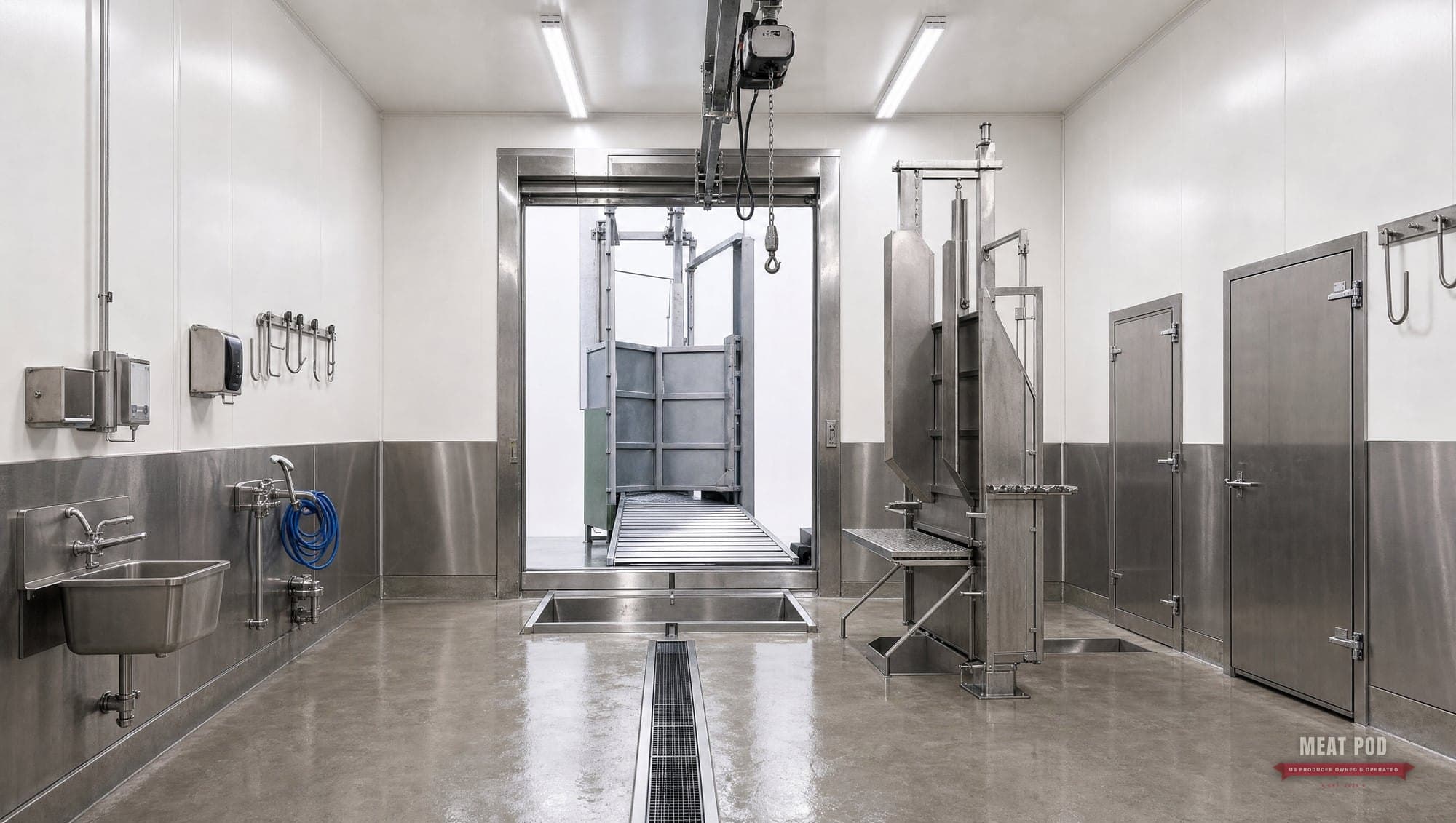
Harvest
The animal walks in from the exterior knock box and never leaves your ground again.
- Exterior humane knock pen and knock box
- In-floor blood collection basin
- Hoists, fairleads, and skinning cradle
- Splitting saw on track, inline rail scale
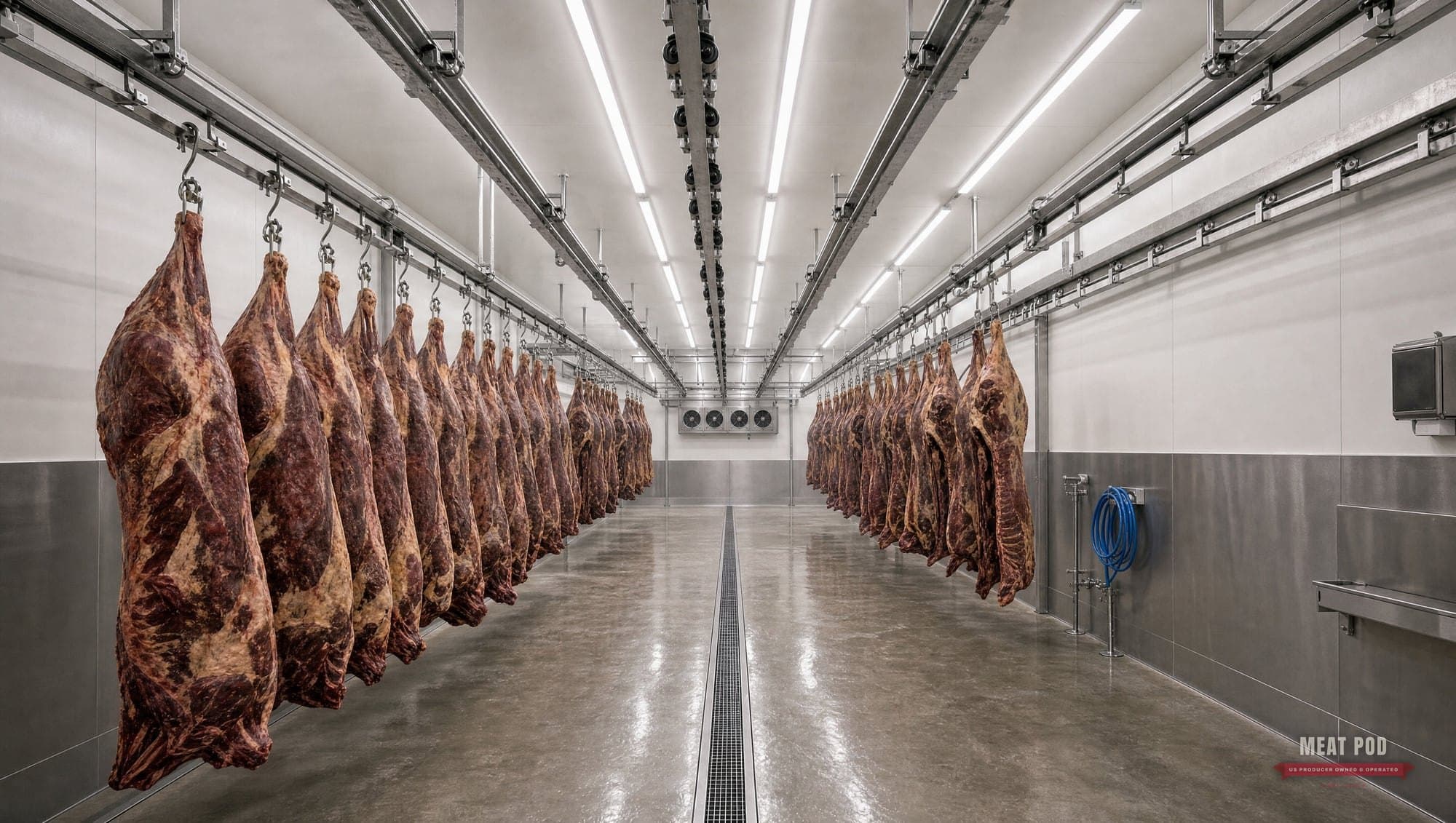
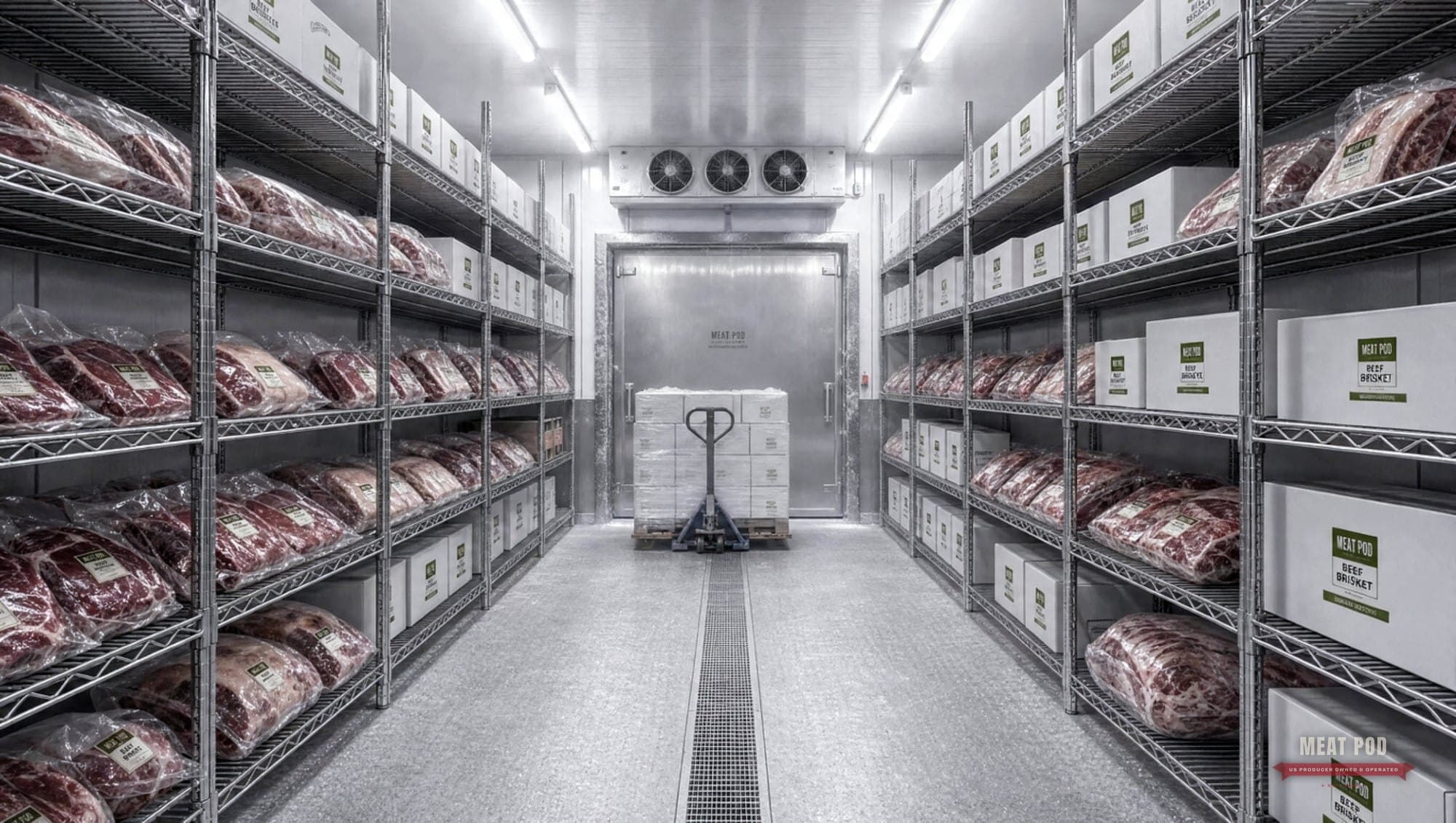
- Drawdown cooler: 15 head at 800 lb
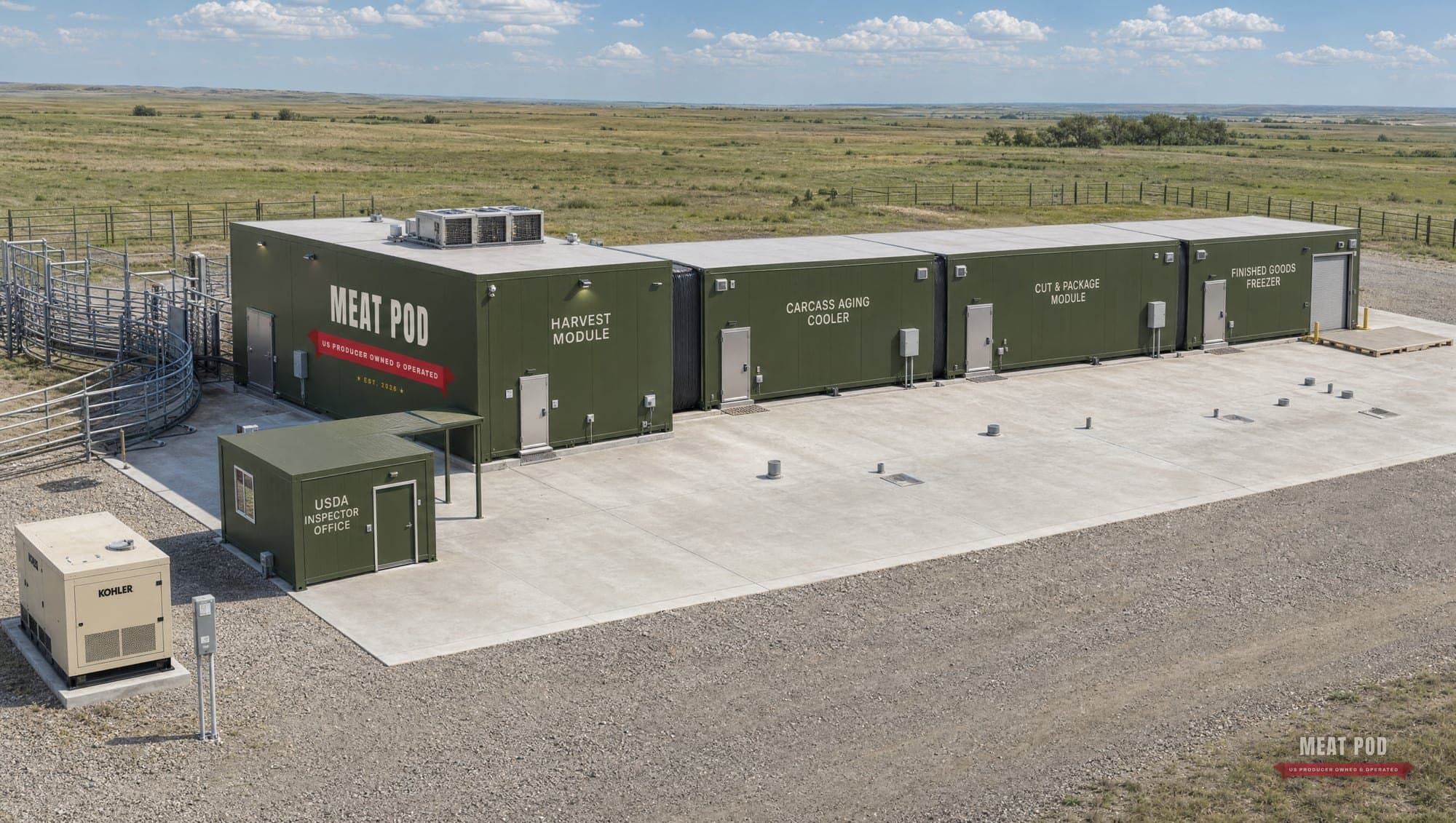
One modular meat processing plant. Four modules.
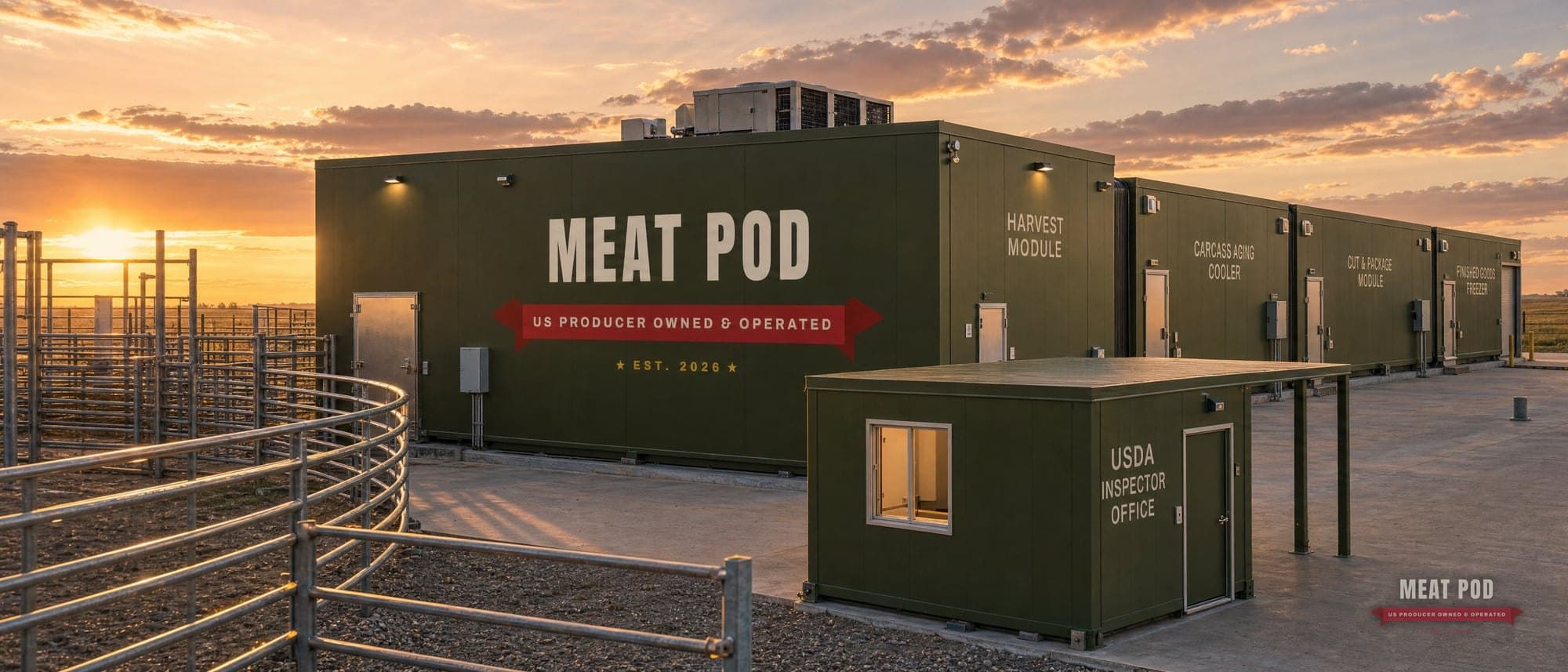
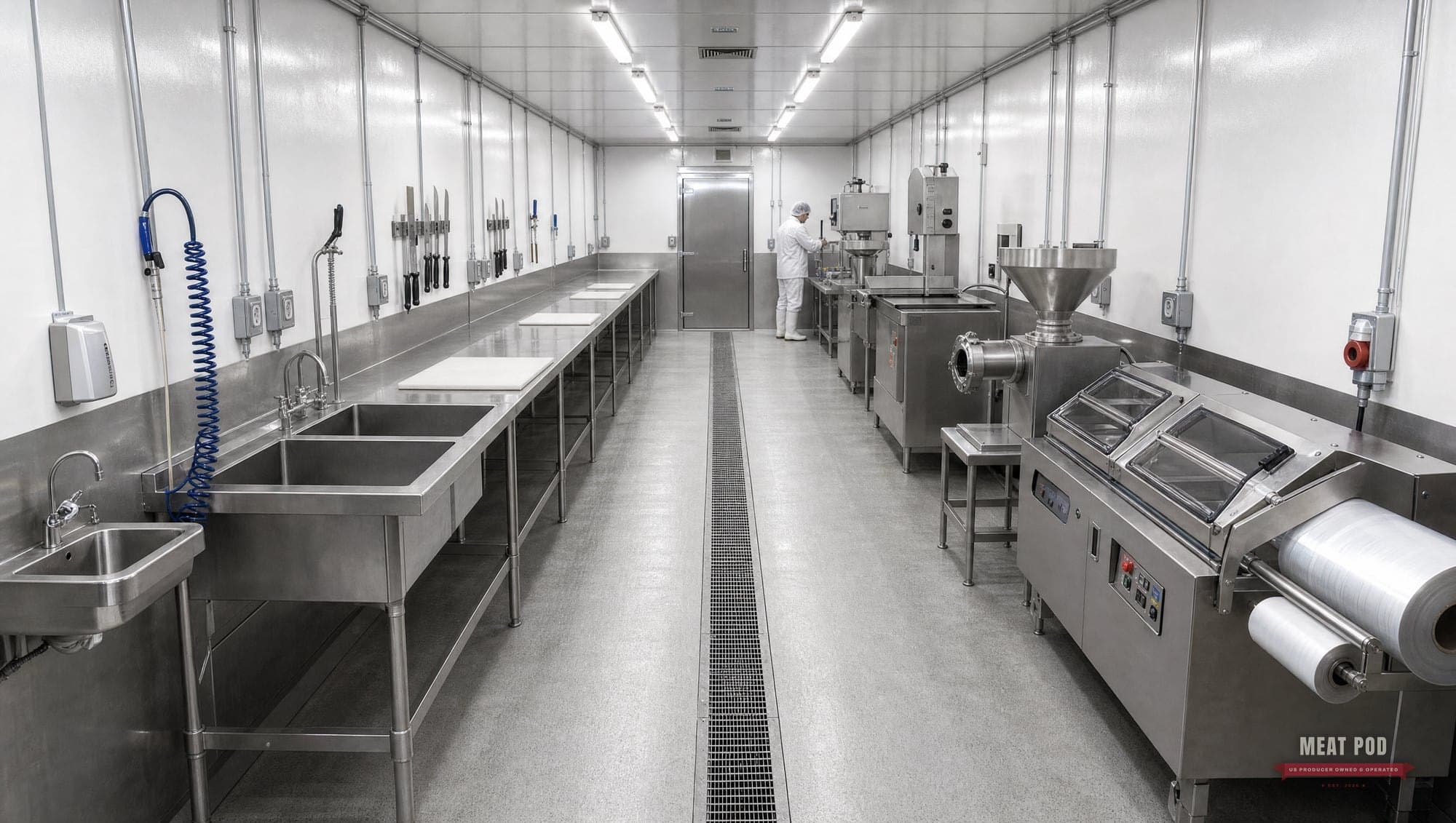
A continuous string of insulated modules rated for 15 head of beef per day per harvest module, or the species equivalent, and configured up to 50 head a day or more by adding modules on the slab. Delivered to your slab, connected, and inspected.
Buy a pod outright and you take all four. Franchise a territory and you take the first two: cut, package, and cold storage happen at Iron Brand regional plants, which pick up wholes, halves, and quarters from your aging cooler.
Concept rendering. Final equipment layout per manufacturer drawings.
Humane handling, stunning, bleeding, hide removal, evisceration, splitting, weighing, and inspection under one 18-foot ceiling. An exterior knock box at the intake wall releases the animal directly onto the harvest floor.
- Exterior humane handling knock pen and knock box
- In-floor blood collection basin
- Hoists, fairleads, and skinning cradle
- Offal cart, inspection trays, offal and hide doors
- Carcass splitting saw on track and balancer
- Inline rail scale and operator platforms
- Dedicated 50 foot-candle inspection lighting
- Carcass drawdown cooler: 15 head at 800 lb, 10 ft rail
Every site built to the same standard.
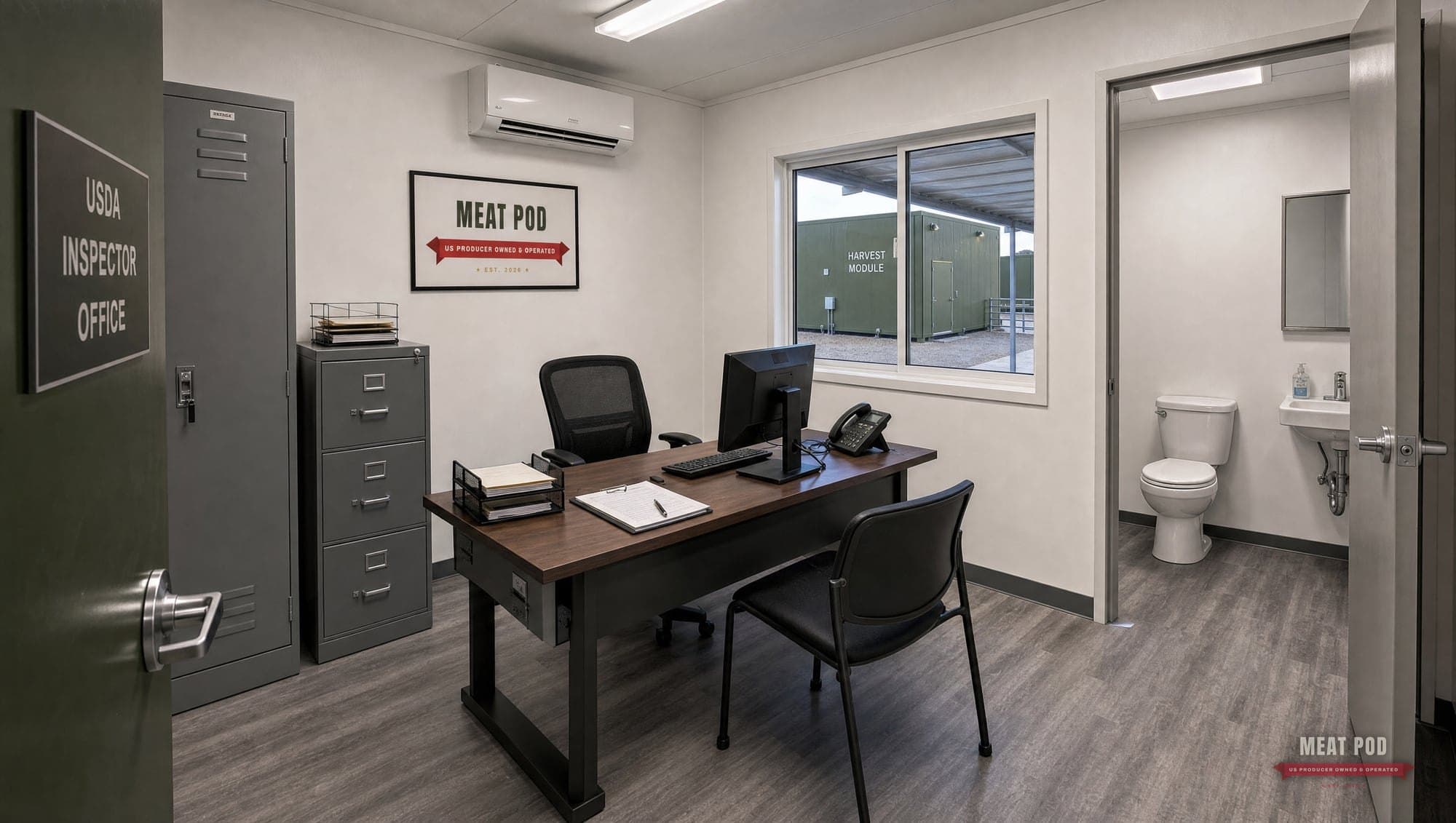
USDA inspector office on site
A private, lockable 10 by 8 office with its own bathroom, climate control, and internet, connected to the harvest module by a covered walkway. Built to the federal inspection facility requirements from day one.
Expansion-ready slab
The concrete pad and underground utilities are sized for the full future footprint. Adding capacity means craning in the next module and bolting it on, not breaking concrete.
Backup power and utilities
Exterior-mounted three-phase service inlet, standby generator, and rubber-boot connections between modules so the cold chain holds through an outage.
Multi-species, one line
The harvest module is configured for beef and re-dressed for hogs. A separate poultry pod design extends the same standard to birds.
Want one on your ground? Get on the list.
We consider four to seven applicants per state per quarter, in the order producers commit. Tell us where you are and how many head you run, and we will call with a site timeline and the next steps. No cost, no commitment.
- Any state. Enough producers in one area anchors a regional custom packing plant and local distribution
- Timeline is driven by site prep: slab, utilities, and livestock handling
- Our in-house SBA specialist walks you through funding before you sign anything
A business in a box.
What the franchise fee and the platform fee buy. The plant is the hardware; this is everything that makes it a business on day one.
Exclusive 50-Mile Territory
A protected radius where no other Meat Pod franchisee can operate, with right of first refusal on the territories next to yours as you grow.
Your Brand, Backed by Ours
Your ranch or family brand stays on the package and in the consumer scan. Meat Pod marks, signage, and packaging certify the system behind it. We back your name, we do not replace it.
Marketing and Demand
A pre-built site, local SEO, ads, and email for your territory, plus regional demand aggregation that routes retail, restaurant, and institutional orders to your pod.
Playbook and Compliance
SOPs for harvest, cut and wrap, packaging, labeling, and traceability. A pre-built HACCP plan and SSOPs, regulatory liaison, and mock inspections, so the pod and the paperwork pass together.
Buying Power and Platform
Pre-negotiated rates on vacuum bags, knives, sanitizer, packaging, and ear tags, and the platform behind the plant: order management, customer records, traceability, and dashboards.
Financing Introductions
Pre-vetted lenders for the pod: SBA and USDA-guaranteed loans, ag lenders, equipment financing, processing grants, and state programs. Our in-house grant and SBA specialists walk you through.
See financing and grantsOne animal, one record, from the ranch to the shelf.
Every station in the pod, every truck, and every package writes to the same record. Our AI traceability app reads it back as compliance, yield, and a story the buyer can scan. It ships only with the franchise, because it is the connective tissue of the whole Meat Pod chain.
Reception and registration
- Ear tag or RFID read
- Live weight on the pen scale
- Ranch of origin, feed program, days on feed
- Ante-mortem inspection result
- Tag
- 840 003 214 887
- Ranch
- Custer County, NE
- Live wt
- 1,412 lb
- Program
- Finished 148 days
Example data for illustration.
USDA paperwork writes itself
Ear tag to carcass tag to lot to package, with inspection dispositions and temperature logs attached. The record the inspector wants is the record the system already keeps.
Yield you can see, not guess
Hot weight, cold weight, and retail yield by primal against target, per animal. When a lot comes up short, you know which station lost it.
Feed program tied to the grade
Days on feed and the ration follow the animal through to the grade and the yield. The nutritionist learns what finishes best, and the next pen is fed to match.
Your name on every package
Your ranch or family brand is the name the consumer sees and scans. The QR opens your story, your history, and a link back to your own site. Meat Pod is the system behind the label, never the name in front of it.
Cold chain to the door
Scanned on the truck, scanned off, temperature logged in between. The account gets proof, not a promise.
Recall in seconds
Any package traces back to its animal, its pen, and its ranch instantly. A recall is one lot, not a season.
Full system details are shared after the discovery call. Buy-outright owners can license third-party traceability software; the Meat Pod app is reserved for franchisees.
Book the discovery callWhat runs through a pod.
A pod earns three ways: your own beef sold at retail value instead of live weight, processing fees from the producers around you, and, under the franchise, shelf and restaurant placement through the Meat Pod chain. How much that adds up to depends on your head count and your neighbors', so instead of printing a projection we built the calculator. The per-head figures below are where it starts.
head per day per pod, with room on the slab to grow
of every retail beef dollar reaches the farm (USDA ERS, July 2026)
1,350 lb at $2.19/lb live, or 586 lb of retail cuts at $8.75/lb
$1,000 kill fee plus $1.25/lb on 837 lb hanging, paid by your neighbors
Your head count, your live price, your miles to the plant, and your neighbors' cattle. Two minutes.
Operators building for operators.
Meat Pod is a Nebraska Farmers Network venture — built by producers who understand the land, the animals, and what it actually takes to close the infrastructure gap.
Franchisor & Operating Entity
Nebraska Farmers Network
Member-driven ag platform spanning land, auction, financial services, and food infrastructure. Headquartered in Lincoln, Nebraska. NFN provides the system, compliance, technology, and demand aggregation that makes the pod work at scale, behind each producer's own brand.
Pod Design & Manufacturing
Meat Pod
A production-ready four-module plant engineered to USDA standards and built to one repeatable site standard: harvest module, carcass aging cooler, cut and package module, and finished goods freezer, delivered as a connected string on a single slab. Traceability software is source-code escrowed.
Operating Leadership
Led by the guidance and experience of more than 500 farmers and ranchers of the Nebraska Farmers Network.
Producer-members who raise the cattle, own the ground, and sit on the other side of the packer gate every day. Meat Pod is built by them, for the American farmer and rancher who has carried the whole chain for generations and kept the smallest piece of it. Who is done handing half of every beef dollar to someone else. Who is done having their livelihood decided by bureaucrats in Washington. Who wants the margin, the control, and the freedom back on their land and their operation, so the next generation has a reason to stay.
How on-site processing compares to the conventional chainInformational only. Franchise opportunities are offered solely in jurisdictions where lawful and following delivery of the Franchise Disclosure Document and all required state filings. No earnings, revenue, or performance claims are made or implied. © 2026 Nebraska Farmers Network, LLC.
Ready to talk? Schedule a call.
Pick a date and time that works for you. Prefer to talk first? Contact the team.
Loading the scheduler…
By submitting, you agree to receive franchise information from Meat Pod. No franchise fee is collected at this stage.
Frequently Asked Questions
What is the difference between buying a pod and franchising a territory?+
Both put a USDA-inspected four-module plant on your ground. Buy a pod outright and the plant is yours with no royalty and no system to follow, but so is everything downstream: freight, finding buyers, marketing, staffing, HR, payroll, and keeping USDA, county, and state compliance current. Franchise a territory and the plant plugs into the chain Meat Pod already runs, from the LandChain and Legacy Exchange producer network to Iron Brand custom packing, Meat Pod freight and distribution, and placement on retail shelves and with restaurants and institutions, with staffing, HR, payroll, and regulatory upkeep handled. Franchisees also need fewer modules: harvest and aging on your ground, while wholes, halves, and quarters are picked up for cut, pack, and cold storage at Iron Brand regional plants. You raise and process the beef; the franchise handles the rest.
What did the September 4 executive order actually do?+
Signed at the White House on September 4, 2026, one week after the President said ranchers should have the right to process their own food. It directs USDA to clear the path for producers to process and sell their own meat, backed by $500 million for small and mid-sized beef processors and $20 million to cut overtime and holiday inspection fees for small plants. It does not build a plant. The right to process is only worth what you can process, which is what a pod on your ground is for.
Do I lose my ranch or family brand?+
No. The opposite. Your ranch or family brand is the name on the package, and when a consumer scans it they see your ranch, your history, and a link back to your own site. Meat Pod is the system behind the label: the plant, the inspection, the traceability, the freight, and the marketing that gets your name onto shelves. We are not replacing a brand you spent years building. We are putting it in front of more people.
What is the total investment required?+
The $25,000 franchise fee covers territory, training, and onboarding. That fee, the 6% royalty, and the $1,500 monthly platform fee are the current founding-network terms and are subject to change as the producer network grows; the Franchise Disclosure Document in effect when you sign governs. The pod itself is priced by our manufacturing partner and is being finalized now; we walk through the current number, your configuration, and your financing stack on the discovery call. Most owners finance the large majority of it through SBA and USDA-guaranteed loans, processing grants, and equipment financing, with our in-house grant and SBA specialists doing the work. Meat Pod introduces lenders but does not finance pods directly.
How does $0 down equipment financing work for a pod?+
Through our partnership with Allison Leasing Company, qualified producers can finance the pod and its modular build as capital equipment with no down payment, subject to credit approval. You do not sell a set of calves, liquidate ground, or drain the operating account to get started. The plant starts earning from the first head processed, and the payments come out of margin you were not capturing before.
Is there a balloon payment or buyout at the end of the term?+
No. The Allison Leasing structure is a straight five-year equipment agreement: 60 level monthly payments, no balloon, no end-of-term buyout. When the last payment clears, the harvest, aging, cut, and packaging equipment is yours outright. Final terms are set in your own agreement with the lender.
Can I stack USDA grants on top of the financing?+
Yes, and that is the point of the stack. The pod is designed to qualify for federal and state processing programs, including the USDA Meat and Poultry Processing Expansion Program, so grant dollars can cover site prep, utilities, and startup costs while the equipment financing covers the pod itself. Our in-house grant and SBA specialists handle the applications alongside your financing paperwork.
Why is a pod easier to finance than a conventional plant?+
A brick-and-mortar plant is a multi-year commercial construction loan with a full corporate balance-sheet review. A pod is underwritten as modular capital equipment, the way a lender looks at a combine or a feed truck. That means a faster approval, a lighter file, and a decision measured in weeks rather than seasons.
Can a smaller family ranch qualify, or is this only for large operations?+
Family ranches are who this is built for. Underwriting looks at the whole operation, including the new margin from processing and selling your own beef and from harvesting for neighboring producers, not just historical bank ratios. If you run cattle and have a place for the pod, start the funding intake and let our team run the numbers with you.
Do I need meat processing experience?+
No. Under the franchise, Meat Pod staffs the plant and handles hiring, HR, and payroll, so you are not expected to run a kill floor yourself. What we do require: an owner who stays involved, capital qualifications, and willingness to follow the system. If you buy a pod outright instead, staffing is yours, and we provide training and SOPs to get your crew certified.
How long until the pod is operational?+
Plan for three to six months from Franchise Agreement signing to first harvest. Site selection, permitting, and site prep run alongside the pod build, so the modules arrive as the slab and utilities are ready. USDA certification and crew training close out the window. Producers whose site prep is already done land at the short end.
How far can a pod be from my operation?+
Anywhere in Nebraska to start, with more states opening as franchise registration completes. The pod sits on your ground or a partner site, so the cattle move miles instead of states. Distance to us does not matter; distance from your cattle to the pod is what you are optimizing.
What decides how fast a pod can be placed?+
Site pre-work. The concrete slab, three-phase power, water and sewer, and livestock handling have to be ready before the modules are craned in. Producers who start the funding intake and site planning early get placed first. Get on the list and we will give you a timeline for your site.
How many applicants do you take?+
We consider four to seven applicants per state per quarter. Each pod needs site work, inspection, and a place in the supply chain, and we would rather place a few well than many badly. Applicants are considered in the order they complete the funding intake and discovery call, so starting early matters more than anything else.
What is the exclusive territory?+
Each franchisee receives an exclusive 50-mile radius from their pod location. No other Meat Pod franchisee can operate within that radius. You also receive right of first refusal on adjacent territories as you grow.
What does the platform fee cover?+
The $1,500/month platform fee covers: national and local marketing fund allocation, technology platform (order management, traceability, dashboards), your dedicated Franchise Business Consultant, ongoing training and certification, and performance benchmarking.
Can I see financial projections?+
Yes — Item 19 of the Franchise Disclosure Document (FDD) contains detailed financial performance representations. The FDD is provided after initial qualification, per FTC Franchise Rule requirements. The figures on this website are illustrative projections, not historical results.
How do the pods capture extra revenue from waste and byproducts?+
Instead of paying to haul away offal, hides, and tallow, a pod can be set up to turn them into secondary income. The simplest step is selling the drop raw: hide, offal, and tallow go to a renderer or pet food maker as they come off the floor, which is the same drop credit the big packers earn on every head. The next step is processing on site: rendering tallow, using hides for pet chews, and drying organ meats for pet treats, which carry higher margins but are regulated products with state feed registration and labeling rules. Whatever is left can go through a zero-odor soil absorption system that feeds pasture growth, or through a conventional rendering pickup. The revenue calculator has a byproducts section so you can see each option on your own head count.